

Self-leveling concrete: DIY vs. hiring a pro
Bags of self leveling cement are on the shelf at every hardware store. Here is what they can and can not do, how to use them, and when a professional concrete floor leveling job is the cheaper option in the end.
Faster quote: send photos of your floor on WhatsApp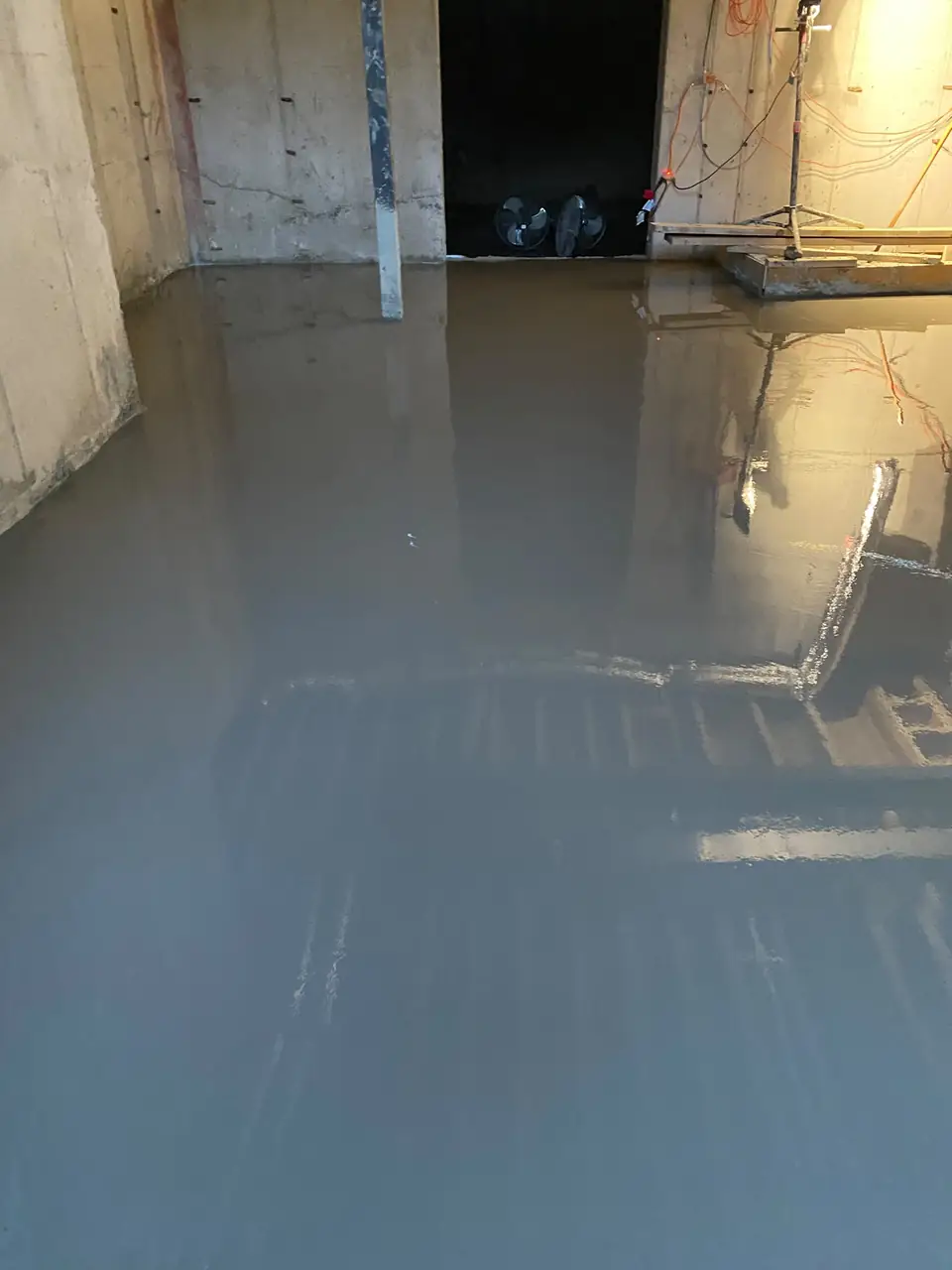
Self leveling cement, compound or underlayment — what is the difference?
Self-leveling cement, self-leveling compound, floor leveling compound and floor leveler are names for the same product family: a flowable, cement-based topping that spreads out and levels itself. Professionals call it cementitious self-leveling underlayment.
Self-leveling products differ in three ways that matter: how thick each one can be poured in a single lift, how long the working time is, and which floor coverings it is rated to go under.
Store-bought self-leveling: Home Depot, Mapei and Sika products
Self-leveling concrete at Home Depot and other hardware stores comes as bagged underlayment from brands such as Mapei, Sika and Henry. These are good materials, and many professionals use the same brands in pump-grade versions.
A single bag typically covers only a few dozen square feet at about 1/8 inch — check the coverage chart on the bag. That makes a bagged leveler a realistic DIY choice for a small bathroom or a low spot, but a basement means mixing and placing a lot of bags back-to-back before the first one starts to set.
Leveling a floor with leveling compound: the DIY steps
Leveling a floor with leveling compound yourself follows six steps:
- Remove old flooring, adhesive and paint so the slab is clean and sound (this is where most DIY pours fail).
- Fill cracks and holes, and dam off doorways, drains and edges.
- Prime the slab with the primer the manufacturer specifies.
- Mix each bag with the exact amount of water on the bag — too much water weakens it and causes cracking.
- Pour continuously, working away from the first pour and keeping a wet edge; spread with a gauge rake and pop air bubbles with a spiked roller.
- Stay off it for the time on the bag and wait before installing flooring.
Work time is short — often only minutes per batch — so on anything bigger than a small room you need several people mixing and pouring at once. That is the main reason larger DIY pours end up with ridges and cold joints.
Whichever product you buy, follow its technical data sheet for primer, maximum thickness per lift and cure times; Mapei, Sika and Henry publish them on their Canadian websites.
Sikaflex self-leveling sealant is not a floor leveler
Sikaflex self-leveling sealant is a polyurethane joint sealant, not a floor leveler. A self-leveling sealant flows into horizontal joints and cracks in driveways and sidewalks so it sits flat; it is not designed to level a whole floor.
Crack fillers & patchers for small repairs
For small cracks, a tube of concrete crack filler is a reasonable quick fix, and a vinyl patching compound such as Quikrete vinyl concrete patcher can repair shallow chips. They are not meant for wide, moving or spalled cracks, or for anything that will sit under tile or LVP — that needs a proper concrete patching and crack repair.
What self-leveling will not fix: foundation walls
Self-leveling concrete is the wrong product for a cracked foundation or basement wall. Repairing a leaking foundation wall crack is a waterproofing job, usually done with injection from the inside or a membrane from the outside, so call a foundation or waterproofing specialist. MIR works on the floor slab, not the walls.
When to hire a pro instead
Hire a professional floor leveling crew when any of these apply:
- The area is more than one small room, or the pour has to be one continuous pass.
- The floor is more than about 1/4 inch out of level, or has old adhesive and paint to remove first.
- You are installing engineered hardwood, large-format tile or LVP with a flatness spec in the warranty.
- The slab is over radiant heat, or it is a condo, commercial or rental unit on a deadline.
- You need a written flatness report for a builder, condo board or insurer.
DIY vs. professional concrete floor leveling cost
Professional self-leveling concrete typically costs $4–$9 per sq ft installed in Ontario, including grinding, crack repair, priming and a laser-checked flat result. Bagged DIY material looks cheaper per bag, but the real cost adds primer, tools, rental mixers, extra bags for waste and, too often, redoing a failed pour. MIR measures the slab for free before you decide.
| DIY bagged self-leveler | Professional pour (MIR) | |
|---|---|---|
| Best for | A small bathroom or a single low spot | Whole basements, condo suites and commercial floors |
| Coverage | A few dozen sq ft per bag at about 1/8 in | Pump-grade material placed in one continuous pour |
| Working time | Minutes per batch; anything bigger than a small room needs several people mixing at once | Mixed and pumped continuously by the crew |
| Surface prep | Yours to do: remove adhesive and paint, fill cracks, prime | Grinding, crack repair and priming included |
| Result check | Straightedge and eye | Rotary-laser survey and a written flatness report, typically ±2 mm over 3 m |
| Typical cost | Bags, primer, tools and rentals, plus any redo | $4–$9 per sq ft installed (Ontario planning figure) |
Planning figures only. Every MIR quote is fixed-price after a free on-site laser measurement.
DIY leveling questions.
For a small area or a single low spot, yes. For a whole basement, the pour needs to be mixed and placed continuously by several people, which is why most homeowners hire a crew for anything bigger than a small room.
Most underlayments are designed to be covered by flooring. If you want a finished concrete look, you need a wear-rated topping or a polished or coated system instead.
No. Sikaflex self-leveling sealant is a joint sealant for horizontal cracks and joints. Self-leveling concrete is a cement-based topping that levels an entire floor.
Professional services.
Self-Leveling Concrete
Pump-grade self-leveling underlayment poured to a laser-set datum.
Learn more / 02Concrete Grinding
Planetary grinding with HEPA extraction — adhesives, paint and stubble gone.
Learn more / 03Concrete Patching & Repair
Cracks, spalls, joints and trip edges — repaired, filled, flush.
Learn moreNot sure if your floor is a DIY job? We'll measure it for free and tell you honestly.
Free concrete floor estimate: tell us about your floor.
Fill in the form and WhatsApp opens with your details ready to send — or just call. We book a free on-site laser measurement anywhere in Whitby, Durham Region, Toronto or the GTA.
- 1We reply within one business dayUsually much sooner during working hours.
- 2Free on-site laser measurementWe map your slab and check what prep it needs.
- 3Fixed-price quote within 48 hoursThe quote is what you pay: no surprises on the invoice.